Do you need a license to roof? Every state, with the source
Signature Roofing Leads: $5 a lead, 50-lead minimum ($250 to start). Roofing Inbound Calls: $150 a call, 5-call minimum ($750 to start), a homeowner with a roof problem already on the line when you answer. How inbound calls work.
A roofer working a list in a state they have not worked before asks this first, and lead vendors never answer it. Here are all 50 answers we could confirm, each with the body that issues the credential and a link to the statute, board or agency it comes from, checked 2026-09-05.
Every state in one table
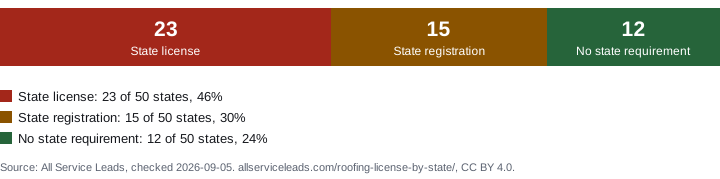
23 states require a license, 15 require registration, and 12 require nothing at state level. The chart above the table shows that split; the table below gives the row for your state, naming the authority that issues the credential and linking the official source the answer was read from.
The split, charted
| State | What the state requires | The answer | Who issues it | Source |
|---|---|---|---|---|
| Alabama | State license | Alabama requires a residential roofers license from the Home Builders Licensure Board once a roofing job exceeds $2,500; commercial work over $100,000 needs a general contractor license. | Alabama Home Builders Licensure Board (residential roofing); Alabama Licensing Board for General Contractors (commercial/general contracting) | Alabama Home Builders Licensure Board — Ala. Code § 34-14A-2 (Definitions) and Alabama Licensing Board for General Contractors, General Contractor Licensing Law ($100,000 threshold) |
| Alaska | State registration | Alaska requires state specialty contractor registration covering roofing from the Department of Commerce, Community, and Economic Development, before you bid or work; no dollar threshold. | Alaska Department of Commerce, Community, and Economic Development — Division of Corporations, Business and Professional Licensing | Alaska Dept. of Commerce, Community & Economic Development — Construction Contractors Statutes and Regulations (AS 08.18.011) |
| Arizona | State license | Arizona requires a contractor license from the Registrar of Contractors for roofing work; casual jobs under $1,000 needing no building permit are exempt. | Arizona Registrar of Contractors (ROC) | Arizona State Legislature — A.R.S. § 32-1151 (Acting as contractor without a license) and Arizona Revised Statutes 32-1121(A)(14), exemptions from contractor licensing |
| Arkansas | State registration | Arkansas requires a roofing contractor registration certificate from the Contractors Licensing Board’s Residential Contractors Committee before residential roofing work. | Arkansas Contractors Licensing Board — Residential Contractors Committee (Arkansas Department of Labor and Licensing) | Arkansas Dept. of Labor and Licensing, Contractors Licensing Board — Residential Licensing Law, A.C.A. § 17-25-603 (rev. April 2026) |
| California | State license | California requires a C-39 roofing contractor license from the Contractors State License Board; casual work under $1,000 needing no building permit is exempt. | Contractors State License Board (CSLB), California Department of Consumer Affairs | California Legislative Information — Business and Professions Code § 7028 and California Business and Professions Code 7048, minor work exemption |
| Colorado | No state requirement | Colorado has no state roofing license; city and county building departments license roofers, while state law sets only written-contract and insurance-deductible rules. | City and county building departments (e.g. Denver, Boulder County, Larimer County). The state Division of Professions and Occupations licenses electricians and plumbers, not roofers. | Colorado Division of Professions and Occupations, occupational professions list (no roofing or general contractor) and Colorado Revised Statutes title 6, including the roofing contract and insurance deductible rules |
| Connecticut | State registration | Connecticut requires a Home Improvement Contractor registration from the Department of Consumer Protection for residential jobs over $200; it is not a trade license. | Connecticut Department of Consumer Protection (Home Improvement Contractor registration, under the Home Improvement Act, Conn. Gen. Stat. ch. 400) | Connecticut General Statutes, Chapter 400 (Home Improvement Contractors), Secs. 20-419 and 20-420 - Connecticut General Assembly |
| Delaware | State registration | Delaware has no roofing trade license; roofers need a Division of Revenue business license and a Department of Labor contractor registration before work begins. | Delaware Division of Revenue (contractor business license, 30 Del. C. ch. 25) and Delaware Department of Labor, Office of Contractor Registration | Delaware One Stop - Construction Contractors (State of Delaware) |
| District of Columbia | State license | The District licenses contractors through the Department of Licensing and Consumer Protection: Home Improvement Contractor for residential work, or General Contractor/Construction Manager. | District of Columbia Department of Licensing and Consumer Protection (DLCP), Business Licensing Division | DC Department of Licensing and Consumer Protection - Contractor and Construction Services |
| Florida | State license | Florida requires a state certified or registered roofing contractor license from the DBPR Construction Industry Licensing Board. | Florida Department of Business and Professional Regulation (DBPR), Construction Industry Licensing Board | The 2025 Florida Statutes, Sec. 489.113 (Qualifications for practice; restrictions) - The Florida Senate |
| Georgia | No state requirement | Georgia does not license roofers at state level; the Attorney General's office lists roofing as an exempt specialty, so city and county rules apply. | No state roofing authority. The Georgia Secretary of State's State Licensing Board for Residential and General Contractors licenses residential and general contractors, but roofing is treated as an exempt specialty; city and county governments set their own requirements. | Consumer Ed - Home Improvement, Georgia Attorney General's Consumer Protection Division |
| Idaho | State registration | Idaho requires roofers to register as contractors under the state contractor registration law, administered by the Idaho Contractors Board; it is a registration, not a trade exam. | Idaho Division of Occupational and Professional Licenses (DOPL), Contractors Board — Idaho Contractor Registration Act, Idaho Code Title 54, Chapter 52 | Idaho Legislature — Idaho Code § 54-5204 (Registration required) |
| Illinois | State license | Illinois requires a state roofing contractor license from the Illinois Department of Financial and Professional Regulation before any roofing or waterproofing work is done. | Illinois Department of Financial and Professional Regulation (IDFPR) — Illinois Roofing Industry Licensing Act, 225 ILCS 335 | Illinois General Assembly — Illinois Roofing Industry Licensing Act, 225 ILCS 335/9 (Licensure requirement) |
| Indiana | No state requirement | Indiana has no state roofing license; the Indiana Attorney General says licensing varies by community, so check the city or county building department. | No state licensing authority for roofing; city and county building departments set the requirements. The Indiana Professional Licensing Agency's list of regulated professions includes plumbing, home inspectors and manufactured home installers, but not roofing, general contracting or home improvement contracting. | Indiana Professional Licensing Agency, licensed professions (roofing is not among them) and Indiana Attorney General, Consumer Protection Division, home improvement fact sheet |
| Iowa | State registration | Iowa requires construction contractor registration with the Department of Inspections, Appeals and Licensing for anyone earning $2,000 or more a year; registration, not a license. | Iowa Department of Inspections, Appeals, and Licensing (DIAL), Division of Labor — construction contractor registration, Iowa Code chapter 91C | Iowa Legislature — Iowa Code § 91C.2 (Registration required — conditions), Iowa Code 2026 |
| Kansas | State registration | Kansas requires roofing contractors to hold a registration certificate from the Kansas Attorney General; it is a registration, not a trade license. | Office of the Kansas Attorney General, Roofing Registration Program — Kansas Roofing Contractor Registration Act, K.S.A. 50-6,121 et seq. (K.S.A. 50-6,124 assigns administration of the act to the attorney general) | Kansas Office of Revisor of Statutes — K.S.A. 50-6,123 and Kansas Statutes 50-6,124, attorney general to adopt rules and forms administering the roofing registration act |
| Kentucky | No state requirement | Kentucky has no state roofing license; the Department of Housing, Buildings and Construction licenses only plumbers, electricians, boiler, sprinkler and fire alarm contractors and inspectors. | No state licensing authority for roofing; city and county governments set the requirements. The Kentucky Department of Housing, Buildings and Construction licenses other construction trades but not roofing or general contracting. | Kentucky Department of Housing, Buildings and Construction (dhbc.ky.gov) |
| Louisiana | State license | Louisiana requires a Residential Roofing or Residential Construction classification from the State Licensing Board for Contractors on residential roof projects worth $7,500 or more. | Louisiana State Licensing Board for Contractors (LSLBC) | Louisiana Revised Statutes 37:2156.4, Louisiana State Legislature |
| Maine | No state requirement | Maine has no state roofing license; the Office of Professional and Occupational Regulation does not license roofers, so municipal permit rules apply. | No state licensing authority for roofing. The Office of Professional and Occupational Regulation (Department of Professional and Financial Regulation) licenses other trades but not roofers; municipalities administer building permits. | Maine Office of the Attorney General, Home Construction and Repair |
| Maryland | State license | Maryland requires a Home Improvement Contractor license from the Maryland Home Improvement Commission for roof repair or replacement on existing homes, with no dollar threshold. | Maryland Home Improvement Commission (MHIC), Division of Occupational and Professional Licensing, Maryland Department of Labor | Maryland Business Regulation Article, section 8-601, Maryland General Assembly |
| Massachusetts | State registration | Massachusetts requires Home Improvement Contractor registration with the Office of Consumer Affairs and Business Regulation for roof work on existing owner-occupied homes of one to four units. | Office of Consumer Affairs and Business Regulation (Home Improvement Contractor registration); Board of Building Regulations and Standards, Division of Occupational Licensure (Construction Supervisor License) | Massachusetts General Laws chapter 142A, section 9, Massachusetts Legislature and Massachusetts General Laws chapter 142A section 1, definition of residential contracting |
| Michigan | State license | Michigan requires a residential builder or maintenance and alteration contractor license covering roofing from the Department of Licensing and Regulatory Affairs; projects under $600 are exempt. | Michigan Department of Licensing and Regulatory Affairs (LARA), Bureau of Construction Codes, Residential Builders' and Maintenance and Alteration Contractors' Board | Michigan Compiled Laws section 339.2404, Michigan Legislature and Michigan Compiled Laws 339.2403(f), exemption below $600 |
| Minnesota | State license | Minnesota requires a residential roofer, building contractor or remodeler license from the Department of Labor and Industry; under $15,000 gross annual receipts is exempt. | Minnesota Department of Labor and Industry (DLI), Construction Codes and Licensing Division | Minnesota Statutes section 326B.805, Minnesota Office of the Revisor of Statutes |
| Mississippi | State license | Mississippi requires a Mississippi State Board of Contractors license for residential roofing over $10,000, and a commercial license above $50,000. | Mississippi State Board of Contractors (MSBOC) — Residential Roofer classification (a subclassification of the residential remodeler license); commercial work under the Board's commercial license | Mississippi State Board of Contractors — Frequently Asked Questions |
| Missouri | No state requirement | Missouri has no state roofing license or registration; the Division of Professional Registration licenses no roofing trade, so cities and county governments license roofers. | No state licensing or registration authority for roofing. The Missouri Division of Professional Registration (Department of Commerce and Insurance) licenses 57 occupations, none of them roofing, general contracting or home improvement. Cities and county governments license roofers. | Missouri Division of Professional Registration — Listings of Professions |
| Montana | State license | Montana requires a construction contractor license from the Department of Labor and Industry, covering roofing; independent contractors with no employees and jobs under $2,500 are exempt. | Montana Department of Labor & Industry (Business Standards Division) — construction contractor license under MCA Title 37, chapter 45, created by HB 239 (Ch. 644, Laws of 2025), which replaced the former Construction Contractor Registration on 1 January 2026 | Montana Code Annotated 37-45-201, Construction contractor license required — application and Montana Code Annotated 37-45-104, exemptions including work under $2,500 and an independent contractor with no employees |
| Nebraska | State registration | Nebraska has no state roofing trade license, but all contractors must register with the Nebraska Department of Labor under the Contractor Registration Act. | Nebraska Department of Labor — Contractor Registration Act (registration, not a trade license) | Nebraska Department of Labor — Contractor Registration: Who Needs to Register |
| Nevada | State license | Nevada requires a state contractor license, classification C-15 roofing and siding, from the Nevada State Contractors Board; the under-$1,000 repair exemption does not apply when a permit is required. | Nevada State Contractors Board — license under NRS chapter 624; roofing falls in classification C-15, "Roofing and siding" (NAC 624.320) | Nevada Revised Statutes chapter 624 (NRS 624.700, engaging in business without a license, and NRS 624.031, exemptions) and Nevada Administrative Code 624.320, classification C-15 roofing and siding |
| New Hampshire | No state requirement | New Hampshire has no state roofing or general contractor license; roofers work under local building departments, which issue permits and enforce the state building code. | No state licensing board for roofing or general contracting. New Hampshire's Title XXX (Occupations and Professions) licenses electricians and plumbers among the construction trades; roofing work is governed by the local building department that issues permits and enforces the state building code. | New Hampshire Revised Statutes, Title XXX Occupations and Professions — table of contents |
| New Jersey | State registration | New Jersey requires roofers to register as home improvement contractors with the Division of Consumer Affairs; a 2024 law adds licensing under a new state board. | New Jersey Division of Consumer Affairs, Office of Consumer Protection (Home Improvement Contractor Business Unit), Department of Law and Public Safety | New Jersey State Board of Home Improvement and Home Elevation Contractors, Division of Consumer Affairs and New Jersey Home Improvement Contractor law, Division of Consumer Affairs |
| New Mexico | State license | New Mexico requires a contractor license from the Regulation and Licensing Department’s Construction Industries Division before doing roofing work. | New Mexico Regulation and Licensing Department, Construction Industries Division | New Mexico Regulation and Licensing Department, Construction Industries Division and New Mexico Construction Industries Licensing Act, NMSA article 13 |
| New York | No state requirement | New York State does not license home improvement contractors; New York City, Buffalo and five county governments do, per the Department of State. | No state licensing authority for roofing; local agencies such as the NYC Department of Consumer and Worker Protection and county consumer affairs offices. Confirmed by the New York State Department of State, Division of Consumer Protection. | New York State Department of State, Division of Consumer Protection - consumer alert on home improvement contractors |
| North Carolina | State license | North Carolina requires a general contractor license from the state Licensing Board for General Contractors when a project costs $40,000 or more. | North Carolina Licensing Board for General Contractors | North Carolina General Statutes 87-1, definition of general contractor ($40,000 threshold) |
| North Dakota | State license | North Dakota requires a contractor license from the Secretary of State when a job's cost, value or price exceeds $4,000. | North Dakota Secretary of State (the registrar under NDCC 43-07-01(5)) | North Dakota Secretary of State, Contractor Licensing and North Dakota Century Code 43-07-02, license required |
| Ohio | No state requirement | Ohio has no state roofing license; the Construction Industry Licensing Board covers only electrical, HVAC, plumbing, hydronics and refrigeration, so local governments set the rules. | Ohio Construction Industry Licensing Board (Ohio Department of Commerce, Division of Industrial Compliance) licenses only five trades, none of them roofing; roofing is regulated by cities and county governments | Ohio Revised Code Section 4740.01 (Ohio Laws, Legislative Service Commission) |
| Oklahoma | State registration | Oklahoma requires roofing contractors to register with the Construction Industries Board, plus a commercial endorsement, passed by exam, for commercial roofing work. | Oklahoma Construction Industries Board (CIB), under the Roofing Contractor Registration Act, Title 59 O.S. 1151.11 et seq. | Oklahoma Construction Industries Board — Active Roofing Contractor Requirements |
| Oregon | State license | Oregon requires roofers to hold a Construction Contractors Board license; state law exempts limited cases, including some casual work under $1,000, but not anyone advertising as a contractor. | Oregon Construction Contractors Board (CCB), under ORS chapter 701 | Oregon Construction Contractors Board — CCB License and Oregon Revised Statutes 701.010(4), exemption for casual work under $1,000 |
| Pennsylvania | State registration | Pennsylvania has no state roofing trade license; roofers exceeding $5,000 of home improvements a year register with the Attorney General's Office as home improvement contractors. | Pennsylvania Office of Attorney General, Bureau of Consumer Protection, under the Home Improvement Consumer Protection Act (HICPA) | Pennsylvania Office of Attorney General — Home Improvement Contractor Registration, Frequently Asked Questions and Pennsylvania Department of State, professional and occupational licensing boards (no roofing board) |
| Rhode Island | State license | Rhode Island requires all contractors to register with the Contractors’ Registration and Licensing Board, and commercial roofers to hold its roofing license as well, except when applying shingles only. | Rhode Island Contractors' Registration and Licensing Board (CRLB), a unit within the State Building Office, under R.I. Gen. Laws chapters 5-65 and 5-73 | Rhode Island General Assembly — R.I. Gen. Laws § 5-65-3 and Rhode Island General Laws 5-73-3, commercial roofing contractor licensing and the shingles-only exemption |
| South Carolina | State license | South Carolina requires a residential specialty contractor registration from the Residential Builders Commission above $500, and an LLR Contractor's Licensing Board license above $10,000. | South Carolina Department of Labor, Licensing and Regulation (LLR) — Residential Builders Commission for residential specialty registration, and the Contractor's Licensing Board for the general contractor license | South Carolina LLR, Residential Builders Commission — Residential Specialty Contractor Registration and South Carolina Code Title 40 Chapter 11 section 40-11-30, $10,000 threshold for general and mechanical contracting |
| South Dakota | No state requirement | South Dakota has no state roofing license; roofers need a Department of Revenue contractor's excise tax license and must check each city's and county's rules. | No state roofing licensing board. The South Dakota Department of Revenue issues the contractor's excise tax license; cities and county governments issue roofing contractor licenses. | South Dakota Department of Revenue — Contractor's Excise Tax and South Dakota Department of Labor and Regulation, occupational and professional licensing boards |
| Tennessee | State license | Tennessee requires a contractor license from the state Board for Licensing Contractors for roofing projects of $25,000 or more, including materials and labor. | Tennessee Board for Licensing Contractors, Department of Commerce & Insurance | Tennessee Board for Licensing Contractors — How to Get a License: Contractor (tn.gov) |
| Texas | No state requirement | Texas has no state roofing license; the Texas Department of Licensing and Regulation does not license roofers, so city and county rules apply instead. | No state licensing authority for roofing; the Texas Department of Licensing and Regulation does not license roofing contractors, and cities and county governments set registration and permit rules | Texas Department of Licensing and Regulation, regulated industries (roofing is not among them) |
| Utah | State license | Utah requires a contractor license from the Division of Professional Licensing before doing roofing work, under the state licensing act. | Utah Division of Professional Licensing (DOPL), Department of Commerce | Utah Code 58-55-301, License required — License classifications — Scope (Utah State Legislature) |
| Vermont | State registration | Vermont requires registration, not a trade license, with the Secretary of State's Office of Professional Regulation for residential roofing contracts over $10,000. | Office of Professional Regulation, Vermont Secretary of State | Vermont Statutes Online — 26 V.S.A. § 5501, Registration required (Vermont General Assembly) |
| Virginia | State license | Virginia requires a contractor license from the DPOR Board for Contractors for projects worth more than $1,000, with the class of license set by the size of the job. | Board for Contractors, Virginia Department of Professional and Occupational Regulation (DPOR) | Code of Virginia § 54.1-1103, Necessity for license (Virginia Law, LIS) and Code of Virginia 54.1-1100, definitions of Class A, B and C contractors (Class C from over $1,000) |
| Washington | State registration | Washington requires every construction contractor, roofers included, to register with the Department of Labor and Industries, which takes a surety bond and insurance rather than an exam. | Washington State Department of Labor & Industries (L&I) | Washington State Department of Labor & Industries — Contractors (Register as a Contractor) |
| West Virginia | State license | West Virginia requires a state contractor license before doing roofing work or bidding for it; the statutory exemptions cover owners, employees and utilities, not small jobs. | West Virginia Contractor Licensing Board, administered by the West Virginia Division of Labor (CLBoard@wv.gov, wvclboard.wv.gov) | West Virginia Legislature, W. Va. Code 30-42-6 (Necessity for license; exemptions), West Virginia Contractor Licensing Act |
| Wisconsin | State registration | Wisconsin has no roofing trade license; DSPS Dwelling Contractor certification is required to obtain a building permit for a one- or two-family dwelling. | Wisconsin Department of Safety and Professional Services (DSPS), Dwelling Contractor and Dwelling Contractor Qualifier certifications | Wisconsin Administrative Code SPS 305.31 (Dwelling contractor), Wisconsin Legislature |
| Wyoming | No state requirement | Wyoming has no state roofing license; county governments, cities and towns license contractors, and state law makes each jurisdiction recognise licenses issued by another Wyoming jurisdiction. | County, city and town building departments; Wyoming has no state contractor licensing board (state-level trade licensing covers electricians only, through the Wyoming State Fire Marshal's Office) | Wyoming Legislature, Wyoming Statutes Title 16, W.S. 16-6-1101 (Contractor licenses; reciprocity; requirements) |
Every row was fetched from the official source named in it on 2026-09-05. State rules change, and city and county rules sit on top of them. Confirm with the named authority before bidding work.
Take the whole table: CSV or JSON, both with the authority and the official source URL for every row. Generated from the same answers as the table, checked 2026-09-05. Both are licensed CC BY 4.0: use them anywhere, with credit and a link back to this page, as set out in Cite this data.
Cite this data
Suggested citation, ready to copy:
All Service Leads (2026). Roofing contractor licensing requirements by US state, checked 2026-09-05. Licensed CC BY 4.0. https://allserviceleads.com/roofing-license-by-state/
You may copy, share and adapt this data for any purpose, commercial use included, as long as you credit All Service Leads, link to this page and to the CC BY 4.0 license, and say if you changed anything.
The license covers this compilation, not the statutes, codes and agency pages each row links to, which belong to the states that publish them.
How do I embed this chart?
Paste this snippet into any page. It shows the split from the top of this page, credits All Service Leads the way CC BY 4.0 asks, and links back here. The image is the same file this page draws, generated from the state sources, so what an embed shows changes when those sources are read again.
<figure style="margin:0;max-width:720px">
  <a href="https://allserviceleads.com/roofing-license-by-state/">
    <img src="https://allserviceleads.com/roofing-license-by-state/chart.svg"
         alt="What the 50 states require of a roofing contractor, checked 2026-09-05"
         width="720" height="179" style="width:100%;height:auto;border:0">
  </a>
  <figcaption style="font:13px Arial, sans-serif;color:#5b6270">
    Roofing contractor licensing requirements by US state, checked 2026-09-05.
    <a href="https://allserviceleads.com/roofing-license-by-state/">All Service Leads</a>,
    <a href="https://creativecommons.org/licenses/by/4.0/">CC BY 4.0</a>.
  </figcaption>
</figure>
The chart on its own: /roofing-license-by-state/chart.svg, 720 by 179, no script and no web font. Reuse it under CC BY 4.0 with the credit line above, or take the answers instead from Cite this data.
Which states require a roofing contractor license?
23 of the 50 states here require a state-issued license that covers roofing work: Alabama, Arizona, California, District of Columbia, Florida, Illinois, Louisiana, Maryland, Michigan, Minnesota, Mississippi, Montana, Nevada, New Mexico, North Carolina, North Dakota, Oregon, Rhode Island, South Carolina, Tennessee, Utah, Virginia and West Virginia. In these states the credential is the state's, the state issues a contractor license that covers roofing, usually with a qualifying exam, and working without one is unlawful.
A license in this sense is not always roofing-specific. Several of these states license contractors generally and roofing sits inside a classification or specialty on the same application, which is why the table names the authority rather than a form number.
Most also set a dollar figure below which small jobs are exempt, and the exemption usually disappears the moment a building permit is required. The exact figure is in each state's row, and it is the number worth reading twice, because dividing one job into two contracts to stay under it is specifically prohibited in several of these statutes.
Which states require registration instead of a license?
15 states take registration rather than a trade license: Alaska, Arkansas, Connecticut, Delaware, Idaho, Iowa, Kansas, Massachusetts, Nebraska, New Jersey, Oklahoma, Pennsylvania, Vermont, Washington and Wisconsin. Registration normally means the state requires registration rather than a trade license, which normally means a bond, insurance and a fee rather than an exam, so it is quicker to obtain and proves less about skill.
The practical difference for a contractor is time and money rather than difficulty. Registration is usually a form, a bond and proof of insurance; a license may add an exam, experience requirements and a financial statement.
The practical difference for a homeowner is smaller than it sounds, which is why several of these states pair registration with a written-contract law and a consumer fund rather than an exam.
Which states have no state roofing license at all?
12 of them: Colorado, Georgia, Indiana, Kentucky, Maine, Missouri, New Hampshire, New York, Ohio, South Dakota, Texas and Wyoming. In these the state licenses no roofing trade, so the requirement is whatever the city or county building department sets. That is not the same as no rules; it means the rules are set closer to the job, and they vary between neighbouring towns.
In a state with no statewide requirement, a roofer can be entirely legal in one town and unlicensed two miles away. The building department that issues the permit is the authority worth calling before bidding, and it is the one that will refuse an inspection.
Several of these states still require a general business registration or a contractor tax license, which is a revenue matter rather than a trade credential. Where that is the case the row says so.
Do the states with the most roof damage require the most paperwork?
No, and the pattern runs the other way. Across the 50 states here, the ones with no state license averaged 309 hail reports in 2025, those requiring registration averaged 189, and those requiring a license averaged 116. The busiest hail markets are the easiest to start working in.
8 states sit above the median of 106 hail reports and require no state license at all: Texas, Missouri, Colorado, South Dakota, Kentucky, Ohio, Georgia and Indiana. Texas alone logged 1,453. If you are deciding where to expand, that is the shortest distance between demand and being lawfully able to bid.
Read it as geography rather than cause. Hail concentrates on the plains and through the middle of the country, and those states also happen to regulate contracting lightly; the weather did not produce the statute and the statute did not produce the weather. Nothing here says a light-touch state is a better market, only that the barrier to entering it is lower.
It cuts both ways, which is the part worth sitting with. A low barrier is low for everyone, so the states where you can start fastest are the states where storm-chasing crews from three states away can too. That is a competition fact, not a licensing one, and it is the reason the cost of a lead in a hail market is not the cost of a lead everywhere.
Why does the difference between a license and a registration matter?
It changes what a credential proves, what it costs to get, and what happens if it lapses. A license usually means an exam and a qualifying individual; a registration usually means a bond and insurance. Both make you lawful to bid, and only one says anything about competence.
It also changes who to ask. A license is normally issued by a contractors board with a public lookup and a complaints process; a registration is often held by a consumer-protection office or a revenue department that will confirm status and little else.
For a contractor buying leads across state lines, the useful habit is to check before the first appointment rather than after the first sale, because in most of these states an unlicensed contractor cannot enforce the contract they signed.
Does All Service Leads check whether a buyer is licensed?
No, and it is worth being direct about that. We sell contact data. We do not verify your credentials, we do not verify a homeowner's, and nothing on this page is legal advice. Licensing is your responsibility and the authority named in your row is the one that decides it.
That is also why this page exists in the form it does. A vendor that checked licenses would have a reason to keep its criteria vague; a vendor that does not check is free to point you at the primary source and let you read it yourself.
The rules change. Thresholds move, boards merge, and a statute cited today can be amended next session, so treat the date stamped on this page as its expiry rather than its birthday.
Where do these answers come from?
From the states themselves, across 50 official domains: statutes, administrative codes, contractor boards and consumer-protection offices. Where a sentence spans two documents, both are cited, which is the case for 19 of the 50. Nothing is repeated from another summary of the law.
All 50 were read against their source on 2026-09-05, which is how eight wrong or unsupportable clauses were caught and removed. Two states cited a document that answers a status code without serving its contents, and two more cited a legislative summary rather than the law; all four now cite the page that carries the fact, because a citation nobody can open is worse than none.
Hawaii is deliberately absent: no official source could be confirmed, and a guess dressed as an answer is the failure this page exists to avoid.
Frequently asked questions
How many states require a roofing license?
23 of the 50 states covered here require a state-issued license covering roofing, 15 require registration instead, and 12 leave it entirely to local building departments.
Can I roof in another state on my existing license?
Usually not. A few states have reciprocity agreements for specific credentials, but most require their own license or registration before you bid. Check with the authority named in that state's row before you take the appointment.
What happens if I roof without the required license?
It varies from a fine to a misdemeanor, and in many states an unlicensed contractor cannot enforce the contract or sue for payment. Some states also let a homeowner recover money already paid. The statute cited in each row sets out the penalty.
Does a permit requirement override a small-job exemption?
In most states that have one, yes. The common pattern is an exemption for casual or minor work under a dollar figure that stops applying the moment a building permit is required, which for a roof replacement it usually is.
Is this legal advice?
No. It is a compilation of what official state sources say, with links so you can read them yourself, published by a lead-generation company rather than a law firm. Confirm your own position with the authority named in your state's row.
Working a new state?
The credential is one of three things to check before you buy leads somewhere unfamiliar. The other two are when roof demand actually peaks there, and what a booked job will cost you at your own close rate.
Buyer guides
Start an order →See your state
Last updated: September 12, 2026. All Service Leads (formerly RoofRoof) is a lead-generation service and does not perform roofing work. This page is a compilation of official state sources, not legal advice, and we do not check whether a buyer holds the credential their state requires.